Reading time:
4 mins
Grounding Techniques for When You're Overwhelmed
published
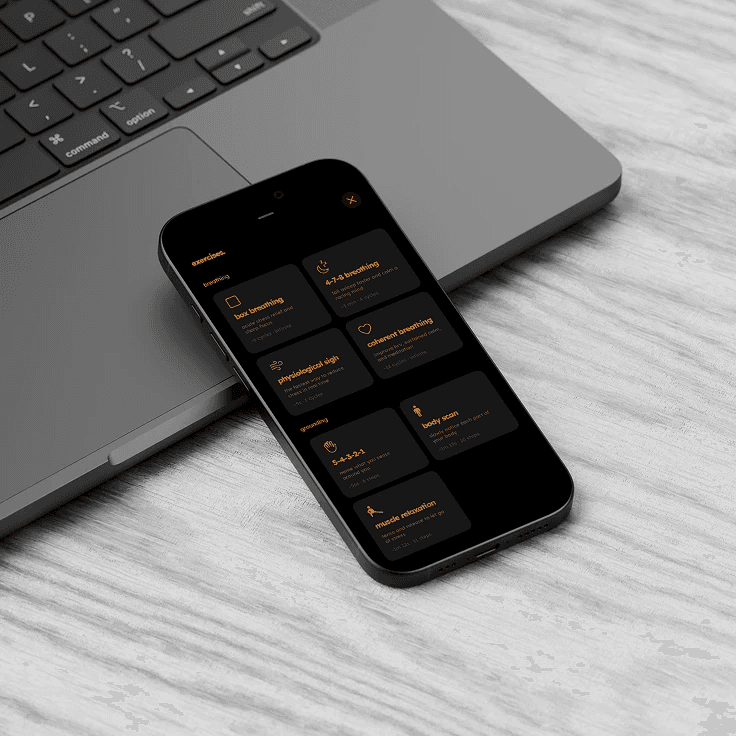
When your mind is racing or you feel yourself sliding toward overwhelm, grounding is the act of pulling your attention out of the spiral and back to the present, usually through your body and your senses. It is one of the most reliable tools there is, partly because it does not ask you to think your way calm. Here are techniques worth knowing, from the well-known to the quietly discreet.
This is general wellbeing writing, not medical advice. If overwhelm is frequent or severe, it is worth talking to a professional.
Why grounding works
Overwhelm lives in your head and your nervous system, not in the present moment. Grounding works by interrupting that loop and giving your attention something concrete to hold instead. The mechanism is physiological as much as psychological: sensory engagement activates the parasympathetic nervous system, which is responsible for the body's calm state. Research supports grounding as an evidence-informed tool for acute anxiety, and it appears in standard DBT and trauma-informed care toolkits for this reason. Because it runs through the senses, it works even when your thinking brain has gone offline, which is exactly when you need it most.
5-4-3-2-1
The classic for a reason. A 2025 trial in nursing students found the technique significantly reduced acute anxiety, with the proportion reporting high anxiety dropping from 23% to 4% after practising it. Small sample, but a real signal. Name five things you can see, four you can feel, three you can hear, two you can smell, and one you can taste. Going through the senses one by one pulls you steadily back into the room. You do not have to finish the whole list, getting started is usually enough.
Breathe out for longer than you breathe in
A long exhale is one of the fastest physical signals that the threat has passed. Research on the vagus nerve shows why: extended exhalations stimulate the parasympathetic nervous system directly, slowing heart rate and signalling safety throughout the body. In for four, out for six, a few times. There is more on this in what to do in the first 60 seconds of sensory overload, which uses the same idea.
A physical anchor
Hold something and give it your full attention. The weight of your keys, the texture of a sleeve, the cool of a wall against your palm. Cold often works especially well, so a glass of cold water or splashing your face can reset things quickly.
Describe one thing in detail
Pick an object near you and describe it to yourself like you are explaining it to someone who cannot see it. Its colour, edges, weight, the way light sits on it. The detail is the point, because it crowds out the spiral.
Grounding nobody can see
Not everyone can do visible techniques in a meeting or on a packed train. Quiet options: press your feet firmly into the floor, push your back into the chair, press a fingertip and thumb together, or follow the feeling of your breath without changing it. All invisible, all effective.
If you go blank
Some people find that mid-overwhelm they cannot remember a single technique, even ones they have used before. This is normal: when your nervous system is flooded, recall gets harder. The most reliable fix is not to memorise more but to have fewer options. Pick one technique, just one, and decide in a calm moment that this is the one you use. The 5-4-3-2-1 works well for this because it has a built-in structure you can follow by rote, even when your thinking brain is not fully online. Some people keep a physical object with them, a smooth stone, a specific ring, a textured keychain, so the anchor is literally in their pocket rather than in their memory.
Keep it somewhere you always have it
The hardest part of grounding is remembering any of this mid-overwhelm. That is why Lullogram's SOS mode walks you through a grounding sequence with haptics, so you can follow it by feel without reading the screen, and quiet cards let you show a short message when speaking is too much. The tools that matter most are free and work offline, because grounding should be there whether or not you have signal.
The next time you feel it building, you only need to remember one of these. That is enough to start.
When grounding is not enough
Grounding is reliable for the acute moments: the spike, the wave, the first minute. It is not designed for what comes after — the debrief with yourself, the pattern of why certain environments tip you over, the longer-term work of building a nervous system that has more capacity before it hits its limit. If overwhelm is a frequent part of your week rather than an occasional visitor, that is worth more than a grounding technique. An occupational therapist or a therapist familiar with sensory processing can help you map what is triggering you and build a wider plan. In the UK, your GP can refer you, or you can look for therapists who list sensory processing or neurodivergence in their specialities.
written By
Rhys Rabaiotti
I am the maker of lullogram, and I am neurodivergent. I build it from my own loud days, for my son and for friends who feel the same things.
More about why I made it
